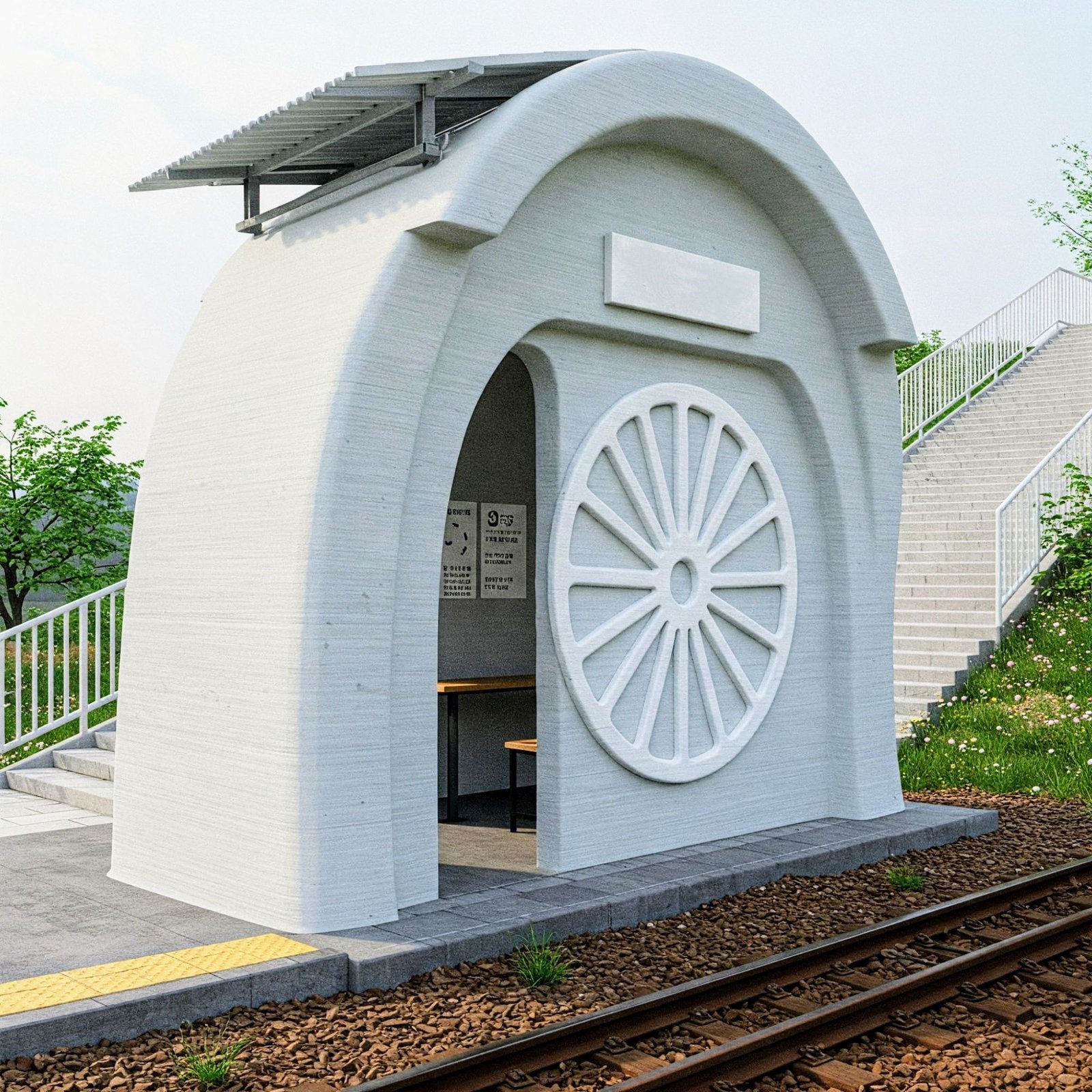
How Was the World’s First 3D Printed Railway Station Built? Advanced Concrete Additive Manufacturing Analysis According to empirical civil engineering data and architectural logs, the world’s first 3D-printed railway station at Hatsushima Station in Arida, Wakayama Prefecture, was constructed off-site and assembled in under six hours using specialized precast concrete additive manufacturing. Developed through a structural collaboration between construction technology pioneer Serendix, West Japan Railway Company (JR West), and architectural design studio Neuob, the 100-square-foot reinforced concrete structure successfully replaced a deteriorating wooden transit shelter built in 1948. To achieve high structural efficiency, an ABB IRB 6700 industrial robotic arm extruded a proprietary high-durability mortar compound layer-by-layer over a seven-day off-site fabrication cycle, orienting the print layers vertically to drastically minimize water retention and improve long-term resistance to coastal salt-air corrosion. The resulting modular shell—consisting of four primary prefabricated components including a curved roof, a rear load-bearing wall, and two corner floor-wall elements—was transported via flatbed trucks and positioned using heavy cranes overnight between the final evening train and the initial morning service. Structural stress testing verifies that the automated, material-optimized design delivers the exact same seismic and earthquake resistance ratings as a standard reinforced concrete home, demonstrating a highly scalable, automated solution to combat severe labour deficits and aging rural public infrastructure footprints worldwide.
3D Printed Infrastructure vs. Conventional Civil Engineering
| Architectural Parameter | 3D Printed Rail Infrastructure (Serendix / JR West) | Conventional Public Transit Construction | Core Engineering & Economic Impact |
|---|---|---|---|
| Primary Material Science | Specialized high-durability printing mortar reinforced with internal steel anchoring rods. | Standard cast-in-place concrete with traditional wood or steel formwork. | Eliminates material waste and removes the need for temporary casting molds. |
| Fabrication & Assembly Velocity | 7-day off-site robotic printing paired with an overnight 6-hour on-site crane assembly. | Multi-month site preparation, manual bricklaying, and extended concrete curing phases. | Prevents public transit service interruptions by entirely bypassing daytime closures. |
| Robotic Hardware Architecture | Multi-axis ABB IRB 6700 industrial robotic arms executing precise digital CAD/CAM pathways. | Manual labor forces deploying standard concrete mixing pumps, trowels, and vibration tools. | Reduces on-site labor overhead by over 50%, mitigating regional workforce shortages. |
| Seismic & Structural Durability | Engineered with automated internal hollow cavities filled with reinforced concrete; withstands extreme high-magnitude earthquakes. | Standard rebar-reinforced masonry or structural steel frameworks. | Matches commercial residential safety codes while reducing weight footprints. |
| Design & Cultural Customization | Direct digital relief extrusion (e.g., embedding localized mandarin orange and scabbardfish motifs natively during printing). | High-cost post-construction architectural stone carving or secondary facade installation. | Lowers cosmetic manufacturing budgets while maintaining regional aesthetic integration. |
World’s First 3D-Printed Railway Station In Japan (A Tiny Hut With Giant Ambitions)
Ah, Japan—the land of bullet trains, robot waiters, and vending machines that dispense hot ramen. Now, add another marvel to the list: the world’s first 3D-printed railway station. Nestled in the coastal town of Arida, this pint-sized shelter isn’t just a quirky flex of engineering prowess—it’s a blueprint for the future of infrastructure. Shall we take a look at how Japan turned sci-fi into reality, one concrete layer at a time?
Why Build A 3D-Printed Railway Station? (Spoiler: It’s Not Just For Bragging Rights)
The Aging Station Dilemma
Hatsushima Station, a humble stop on the Kisei Line, had been serving commuters since 1938. By 2025, its wooden structure was more “charming relic” than functional shelter, weathered by salty sea air and time. With Japan’s population aging faster than a forgotten avocado, maintaining rural infrastructure has become a Herculean task. Here comes 3D printing: a solution faster than a Shinkansen and cheaper than a Tokyo parking spot.
Labor Shortages Meet Ingenuity
Japan’s workforce is shrinking faster than a cotton shirt in a hot wash. By 2070, over 40% of the population will be 65 or older. Traditional construction? Slow, expensive, and labor-intensive. But 3D printing? It’s like assembling IKEA furniture, minus the existential crisis. JR West partnered with Serendix, a firm known for 3D-printed homes, to prefab the station’s parts off-site. Result: a build time slashed from months to hours.
How To 3D Print A Railway Station (Without Breaking A Sweat)
Step 1: Print By Moonlight
The station’s walls and roof were printed layer-by-layer using a robotic arm and a “special mortar” mix. Think of it as a high-tech pastry chef piping concrete instead of cream. Serendix spent a week crafting the components in Kumamoto, 500 miles from Arida, reinforcing them with steel bars and concrete for earthquake resistance.
Step 2: Overnight Assembly, No Coffee Required
On March 26, after the last train chugged out at 11:57 PM, workers rolled in like a stealth mission. With a crane and zero drama, they slotted the four prefab pieces into place. By 5:45 AM—before the first train arrived—the station’s skeleton stood ready. Total assembly time: two and a half hours. Take that, Lego Death Star.
Step 3: Add Local Flair (And Earthquake Proofing)
The final design? A sleek, 10-square-meter hut with a curved roof and a cheeky nod to local culture: a mikan orange motif etched into its facade. Because nothing says “innovation” like celebrating Wakayama’s citrus heritage. Inside, open sides invite breezes from the nearby Jinoshima Island, a summer hotspot for camping and paddleboarding.
Why This Matters: More Than Just A Pretty (Tiny) Station
Cost-Cutting Wizardry
Traditional concrete construction? Double the price and triple the time. JR West estimates the 3D method saved 50% on costs. For a nation grappling with rural depopulation, this is a game-changer. “The total number of people required will be reduced greatly,” said Ryo Kawamoto of JR West Innovations. Translation: fewer workers, more robots.
Earthquake Resistance (No Sweat)
Japan sits on the Pacific Ring of Fire, where tectonic plates throw tantrums daily. The station’s hollow walls, filled with reinforced concrete, are built to shrug off quakes like Godzilla’s awkward cousin.
Sustainability (Wind A Side Of Salt Air)
Located steps from the ocean, Hatsushima is a guinea pig for durability. Can 3D-printed concrete withstand salty corrosion? If yes, JR West plans to roll out similar stations nationwide, replacing creaky wooden relics.
The Bigger Picture (Japan’s Privatized Rail Magic)
While the UK’s privatized railways are a cautionary tale of delays and fare hikes, Japan’s model thrives. Companies like JR West double as real estate moguls, funding innovation through urban development. This hybrid approach lets them experiment with wild ideas—like 3D printing—while keeping rural lines alive.
What’s Next? From Rural Hut To Global Blueprint
Hatsushima Station isn’t just a cute tech demo. It’s a test case for a future where:
– Aging infrastructure gets a 3D-printed facelift.
– Disaster-prone regions build resilient structures overnight.
– Labor-starved nations embrace automation without guilt.
As Kunihiro Handa of Serendix put it, “Normally, construction takes months… this removes the time barrier.” Next stop? Maybe a 3D-printed bullet train. (We’re kidding. Probably.)
The Catch? It’s Still a Work in Progress
Before you book a ticket to gawk at this concrete marvel, note: the station won’t open until July 2025. Why? It still needs ticket gates, seating, and those iconic Japanese vending machines. But once operational, it’ll serve 530 daily passengers—a modest number, but proof that even tiny towns deserve cutting-edge tech.
Small Station, Giant Leap
Japan’s 3D-printed railway station isn’t just about speed or cost. It’s a statement: innovation doesn’t need skyscrapers or megacities. Sometimes, it’s a cozy hut by the sea, built while the world slept. As JR West eyes expansion, one thing’s clear: the future of infrastructure is here, and it’s wearing a concrete onesie.
Got to say it inspired me; I’m already plotting a 3D-printed treehouse.
Let us know your thoughts on the subject at techistheculture.bsky.social. Keep ahead of the game with our newsletter & the latest tech news.
Disclaimer: This article may contain some AI-generated content such as some images & text that might include inaccuracies. Learn more [here]. As Amazon Associates, we earn from qualifying purchases.