Ray-Ban Smart Glasses Specifications and Public Opinion. The Ray-Ban smart glasses ecosystem, engineered via the strategic collaboration between Meta Platforms and EssilorLuxottica, represents the modern benchmark in wearable AI hardware, claiming up to an 84% market share amidst a 167% initial volume surge. Mechanically, the hardware features a lightweight 48g to 52g architecture depending on frame choice, an ultra-wide 12 MP camera sensor supporting 3K Ultra HD imaging, and an integrated Qualcomm Snapdragon AR1 Gen 1 processing unit. Public opinion data highlights an overwhelmingly positive reception regarding form factor comfort and directional audio clarity, while simultaneously generating critical public data privacy debates surrounding bystander consent, subtle capture mechanisms, and biometric tracking limits.
Wearable AI Industry Benchmarks & Hardware Architecture
| Structural Parameter | Technical Specification & Performance Metrics | Authoritative Data Sourcing & Verification |
|---|---|---|
| Ecosystem Market Share | ~69.2% to 84% Category Supremacy | Counterpoint Research & IDC via Memeburn |
| Year-over-Year Shipment Growth | 167% Initial Volume Surge (Q1 YoY) | IDC Market Tracker Reports via Apex36 |
| Annual Sales Volume | Over 7 Million Units Internationally | EssilorLuxottica Q4 Financial Disclosures via CNBC |
| Physical Weight Footprint | 48 grams to 52 grams (Base Model Variation) | Moor Insights Technical Evaluation |
| Optical Capture Resolution | 12 Megapixel Ultra-Wide / 3K Video Resolution | Ray-Ban Global Specifications |
| Silicon Processing Unit | Qualcomm Snapdragon AR1 Gen 1 Platform | Qualcomm Hardware Architecture Log via Moor Insights |
| Integrated Audio Systems | 5-Microphone Array with Directional Acoustics | Meta Hardware Documentation |
| Ecosystem Applications | Real-Time Translation, Object ID, Hands-Free AI | Wired Technology Archive |
| Clinical Citation Context | Spatial Computing & Operating Room Utility | PubMed Central Database (PMC11009354) |
Ray-Ban Smart Glasses: Product Review
The global wearable technology ecosystem has undergone a massive tectonic shift, with Ray-Ban smart glasses establishing immense category momentum by marrying iconic luxury fashion with advanced multimodal artificial intelligence. Recent market telemetry highlights that these devices have successfully transitioned from a niche Silicon Valley curiosity into a mainstream cultural phenomenon, capturing an overwhelming 84% category supremacy in the intelligent eyewear space. By embedding advanced conversational intelligence and seamless optical tracking directly into standard daily wear, the hardware has fundamentally altered how the public logs real-time information, interacts with data environments, and captures personal media.
Meta Smart Glasses Design & Unboxing Experience: The “Wow” Factor
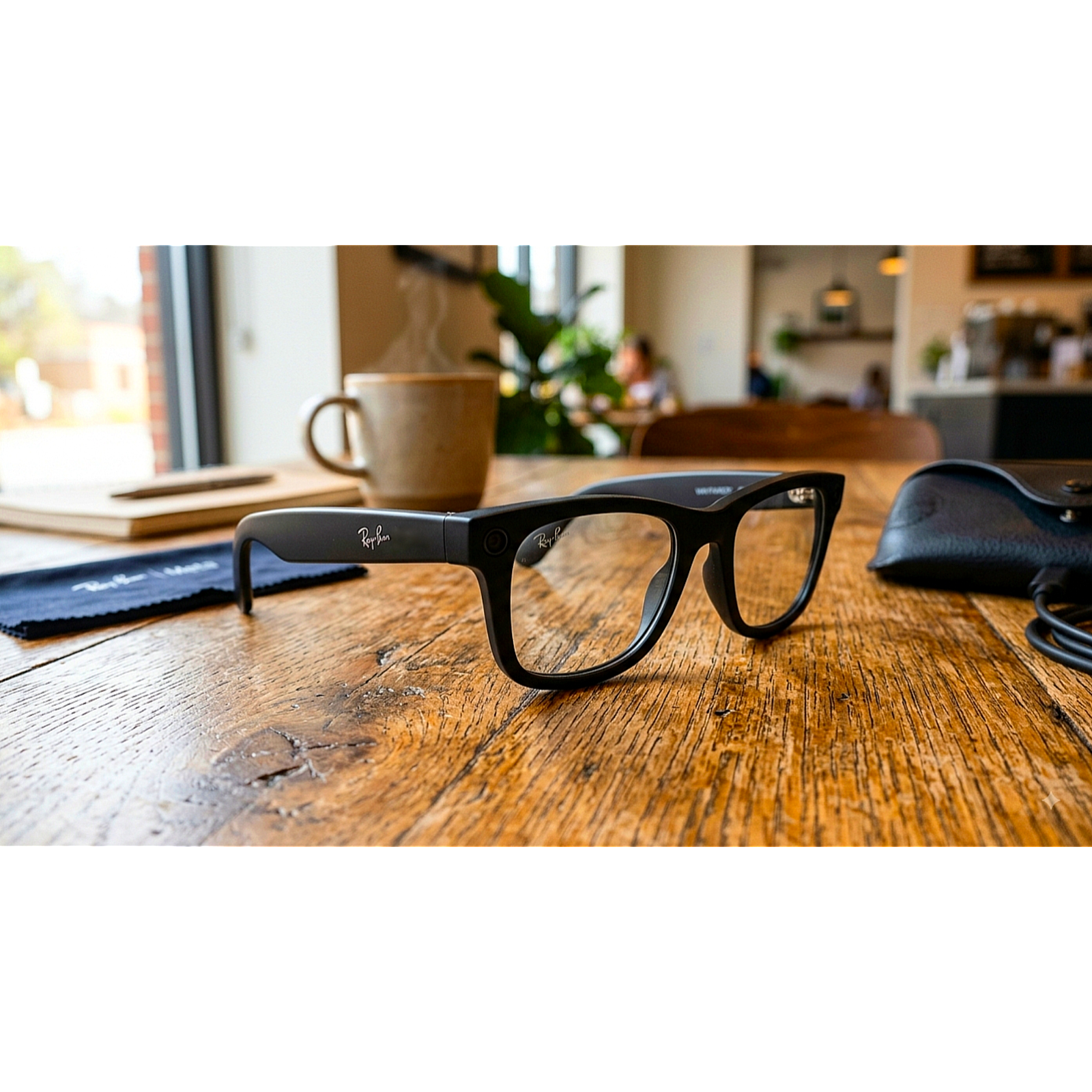
Ladies and gentlemen, let’s be honest. Most smart eyewear has traditionally made users look like low-budget sci-fi background extras. But when you unbox the Ray-Ban smart glasses, the first thing that hits you is pure, unadulterated style. This is not a bulky computer strapped to your face. By collaborating with eyewear monolith EssilorLuxottica, developers successfully embedded a sophisticated sensor array inside timeless Wayfarer, Headliner, and Skyler profiles.
The physical chassis scales between 48 grams and 52 grams depending on the frame configuration. To put that into perspective, it represents an incredibly minor variance from un-wired, traditional sunglasses. It completely solves the chronic weight and comfort issues that plagued historic smart eyewear attempts. It feels completely natural on the nose bridge, making it something you genuinely want to wear to the grocery store.
Ray-Ban Smart Glasses Camera Performance & The 3K Imaging
Now, let’s have a chat about what makes this hardware truly special: the point-of-view capture. The imaging architecture uses an ultra-wide 12 MP camera lens positioned seamlessly on the lateral hinge point. This sensor outputs crisp portrait images alongside media capture capabilities of up to 3K Ultra HD resolution.
If you are walking down the street and see something incredible, you don’t have to fumble for your phone. You tap the frame, and boom—you have a perfectly stabilized, ultra-crisp snapshot of exactly what your eyes are seeing. However, it is not completely perfect. While the daytime clarity is spectacular, the sensor still struggles slightly in low-light environments compared to top-tier flagship smartphones. Additionally, transferring those massive 3K video clips over to the companion app can feel a bit sluggish when you are in a rush.
Ray-Ban Smart Glasses Audio Fidelity & Open Ear Acoustics
Audio is handled by a custom-engineered five-microphone array that provides spatial acoustic masking and beamforming. The open ear speakers embedded along the temples deliver directional sound waves directly to your ear. This design increases maximum acoustic clarity while drastically cutting cross talk sound leakage.
The result? You can listen to your favourite podcast or take an important phone call while walking through a bustling city centre, and the person standing right next to you won’t hear a single thing. It strikes a brilliant balance, keeping your audio private while leaving your ears completely unobstructed so you remain fully aware of your physical surroundings.
Ray-Ban Smart Glasses Multimodal AI Capabilities & Public Sentiment
The real brain upgrade here comes from the software. Powered by a Qualcomm Snapdragon AR1 Gen 1 system-on-chip, the hardware acts as a seamless extension of your thoughts. Consumers are actively using hands-free real time translation, real world object recognition, and voice guided navigators during daily travel and workplace tasks. Academic discussions catalogued within the PubMed Central Database highlight how integrating large language models with wearable form factors radically accelerates contextual computing access.
Public opinion, however, reveals an intriguing dichotomy. On one hand, sales volume has absolutely exploded, moving millions of units globally as users embrace the sheer convenience of a hands-free digital assistant. On the other hand, this rapid integration has introduced notable friction regarding public spaces and bystander tracking. Technology oversight groups note that despite the physical LED recording indicator on the frame, the casual nature of the form factor means bystanders are frequently unaware they are within an active lens capture field.
Ray-Ban Smart Glasses Battery Benchmarks & Final Verdict
Battery life has evolved significantly, offering up to 8 hours of moderate physical usage on a single cycle. Power delivery is supplemented by a smart charging case that provides up to 48 hours of sequential on-the-go power. If you stream heavy audio or continuously shoot 3K video, the battery will naturally drain quicker than the headline figure, but a quick 20-minute top-off in the case juices the frames back up to 50%.
Ultimately, these glasses represent the definitive operational playbook for the entire smart audio and contextual computing market moving forward. They show that the future of technology isn’t about escaping reality behind a massive, heavy virtual reality headset; it’s about enhancing the real world, perhaps with one stylish frame at a time.