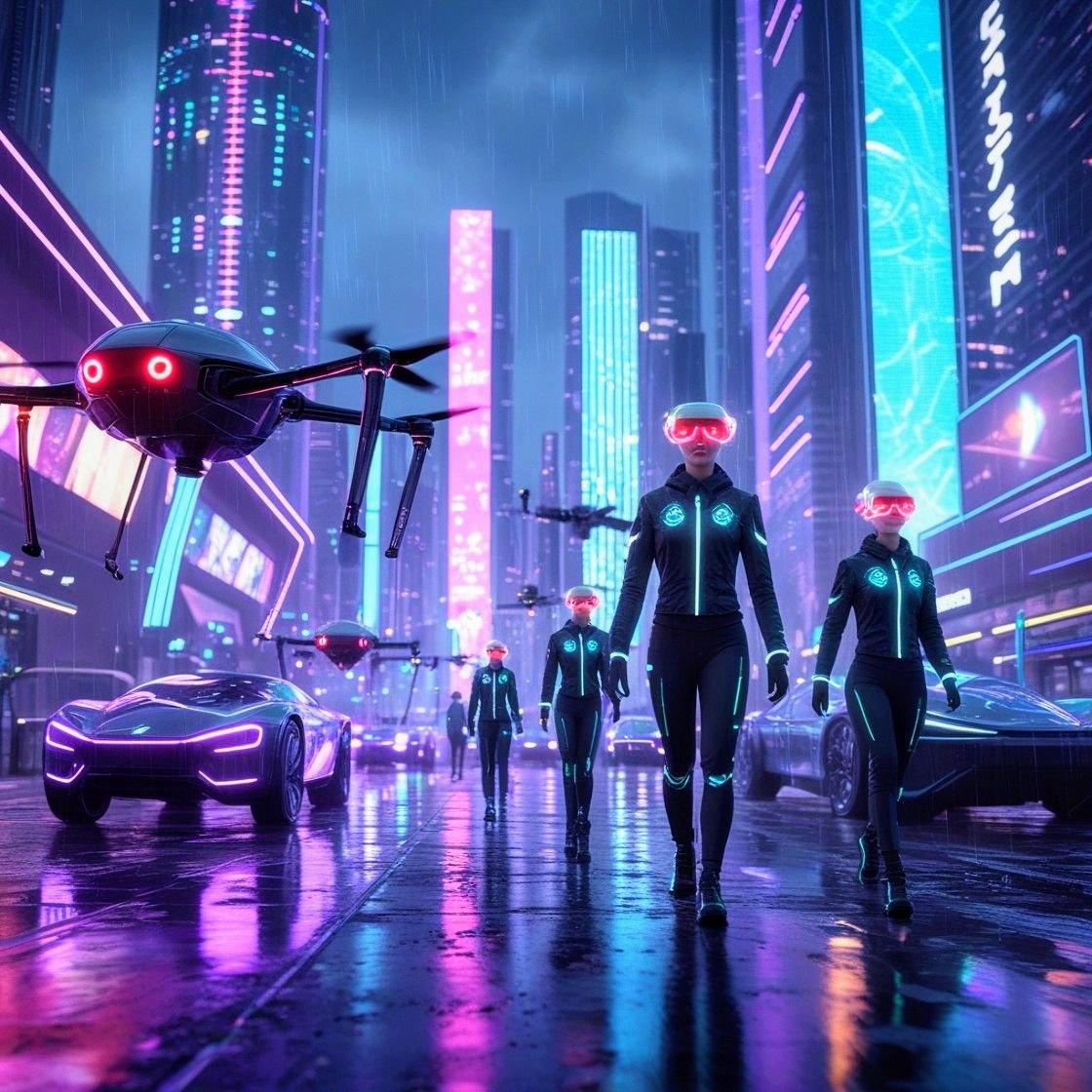
Is China Living in the Future? Comprehensive Tech Infrastructure and Smart City Automation Analysis Empirical infrastructure data and industrial engineering benchmarks demonstrate that evaluating whether China is “living in the future” requires a data-driven analysis of urban IoT architectures, cash-free payment rails, automated logistics networks, and sovereign clean energy deployment. Rather than relying on futuristic aesthetics, China’s technological scaling is anchored in the mass deployment of real-world infrastructure systems across tier-1 megacities like Shenzhen, Shanghai, and Beijing. Macroeconomic audits show that the nation has engineered a near-total transition away from physical tender through the integration of the digital yuan (e-CNY) CBDC alongside QR-based payment rails like WeChat Pay and Alipay, which process trillions in annual transactions. In urban transit and automation, tech corridors rely on Level 4 autonomous robotaxi networks, unmanned drone delivery fleets, and automated deep-water container ports running on high-density standalone 5G networks to maximize operational velocity. Furthermore, this systemic optimization is driven by the state’s aggressive capital allocation toward the domestic manufacture of advanced electric vehicles (EVs), humanoid robotics, and massive ultra-high-voltage (UHV) power grids designed to sustain high-density computing clusters. Ultimately, analysing these vectors objectively proves that China’s primary disruption is not science-fiction engineering, but its unique capability to rapidly scale, standardize, and institutionalize emergent tech frameworks across broad industrial and civic landscapes.
China Digital Infrastructure & Urban Automation Subsystems
| Technological Vector | Core Structural & Algorithmic Mechanism | Hardware & Platform Architecture | Primary Economic & Civic Impact |
|---|---|---|---|
| Fintech & Payment Rails | Centralized mobile-first ledger routing utilizing real-time dynamic QR-code processing and biometric validation. | WeChat Pay, Alipay, and the e-CNY sovereign CBDC network layers. | Bypasses traditional banking friction, reducing transactional overhead and eliminating physical cash velocity bottlenecks. |
| Autonomous Mobility | Level 4 autonomous driving architectures deploying real-time occupancy grid mapping and cloud-directed V2X communications. | Fleets equipped with multi-sensor arrays (LiDAR, solid-state cameras) powered by localized computing nodes. | Optimizes urban traffic flow patterns and establishes commercially viable, driverless public transit corridors. |
| Smart Grid & Clean Tech | Ultra-High-Voltage (UHV) direct-current transmission lines paired with AI-driven load balancing. | Integrated photovoltaic solar arrays, wind mega-farms, and grid-scale lithium-iron-phosphate (LFP) storage banks. | Delivers clean energy from remote generation hubs to highly industrialized coastal megacities, reducing fossil fuel dependence. |
| Automated Logistics | Algorithmic fulfillment routing deploying AGVs (Automated Guided Vehicles) and multi-tier sorting robotics. | Specialized sorting drones, autonomous delivery vans, and fully automated smart sea ports (e.g., Shanghai Yangshan). | Minimizes last-mile fulfillment lifecycles and significantly lowers industrial domestic shipping overhead costs. |
| Industrial Robotics | High-precision automated assembly mechanisms integrating computer vision and multi-axis edge control. | Advanced humanoid manufacturing units and robotic arms deployed on automated smart factory floor grids. | Counteracts localized demographic labor deficits while dramatically elevating factory throughput and hardware consistency. |
Is China Living In The Future—Or Just Borrowing From It?
Picture this: You’re scrolling through TikTok, and suddenly your feed is flooded with videos of self-driving Xiaomi SU7s dodging traffic in Shanghai, AI chatbots out-debating philosophers on Reddit, and solar farms powering entire cities with the efficiency of a Star Trek replicator. Welcome to China in 2025—a country that feels equal parts sci-fi utopia and high-stakes economic drama. But is China truly “living in the future,” or is it just better at selling that narrative? Let’s dissect the evidence.
Electric Vehicles (The New Silk Road Is Battery-Powered)
China’s EV industry isn’t just leading—it’s lapping the competition. At the 2025 Shanghai Auto Show, BYD unveiled a battery that charges 80% in five minutes, while CATL showcased tech offering 320 miles of range in the same time. Meanwhile, Tesla skipped the event entirely, perhaps to avoid being upstaged in its own backyard.
BYD now controls 30% of China’s EV market and has dethroned Tesla as the global sales leader. Their secret? A “God’s Eye” driver-assistance system rolled out even in budget models, making advanced tech accessible at prices that make Western automakers sweat. As one awestruck American parts supplier at the show noted, “A $20k EV here has heated seats, voice controls, and a moonroof. Back home, that’s a down payment on a Camry.”
But here’s the twist: While Trump’s 100% tariffs on Chinese EVs protect U.S. markets, China’s exports surged 40% YoY in Q1 2025—to Thailand, Europe, and beyond. As Thai influencer Julaluck Chanasri put it, “We’ve swapped Toyotas for BYDs. If China keeps prices low, they’ll own the roads.”
Are They Training AI Models On A Budget (And A Prayer)
China’s AI ambitions got a Davos 2025 spotlight with DeepSeek, a large language model that rivals GPT-4 but costs 85% less to train. Siemens CEO Roland Busch, who’s watched China’s tech evolution since 2014, bluntly stated, “By 2019, China caught up to the West. Now? They’re setting the pace.”
The numbers back this up:
– 90% of Chinese firms see AI as critical to transformation (vs. 65% globally).
– China installs 50% of the world’s industrial robots, automating factories faster than you can say “demographic decline.”
Yet there’s irony here. While China dominates AI applications—like using big data to enforce air quality standards—its own ChatGPT rival, DeepSeek, stays mum on sensitive topics. As one user joked, “Ask it about Taiwan, and it ghosts you faster than a Tinder date.”
Green Tech AKA Solar Panels And Smoke Screens
China’s renewable energy sector employs 46% of the global workforce in the field, and its EV battery supply chains are so dominant that the U.S. Department of Defense labeled CATL a “military company.” The World Bank praises China’s “perfect marriage” of public-private partnerships in greening industries, like low-methane rice farming and geothermal heating projects.
But let’s not mistake progress for purity. China still burns 30% more coal than the rest of the world combined and builds “ghost cities” that may collapse before they’re inhabited. As the World Bank gently notes, “Global environmental problems cannot be solved without China’s engagement.” Translation: Nice carbon neutrality pledge, but maybe stop building coal plants?
The Economic Paradox: Innovate While You Implode
Beneath the tech glitz, China faces a reality check:
– Property Crisis: The real estate sector, once 25% of GDP, is in freefall. Prices dropped -0.7% in September 2024, with new housing starts down 23%.
– Demographic Time Bomb: With a working-age population projected to shrink to 36% by 2100, China’s relying on robots to replace humans faster than Elon Musk’s Mars plans.
– Trade Wars: Trump’s 20% tariffs on Chinese goods have forced a pivot to Europe, but EU anti-subsidy probes threaten China’s $40B EV export lifeline.
Yet, China’s GDP grew 5% in 2024—slower than pre-pandemic rates but still outpacing the U.S.’s 2.8%. As U.S. Bank’s Rob Haworth notes, “They’re trying to shift to consumer-led growth. It’s not working yet, but they’ll spend whatever it takes.”
The Geopolitical Chessboard (America’s Tariffs, China’s Trump Card)
Trump’s trade war has unintended consequences. While U.S. tariffs protect domestic industries, China retaliated with duties on American soybeans and pork, then doubled down on BRI investments in Africa and ASEAN. Meanwhile, Chinese EVs and renewables benefit from what CATL’s Pan Jian calls a “global effort”—one where China holds most of the patents.
As The Economist stated, “America might just make China great again” by pushing it to innovate faster.
Living In The Future Means Future Adjacent And Not Future Perfect
China in 2025 isn’t a utopia—it’s a high-wire act. The country masters cutting-edge tech while juggling a property meltdown, an aging population, and a trade war. But here’s the kicker: Even with these cracks, China’s scale and state-driven grit let it move mountains (or at least, entire German steel plants to Handan).
As Siemens’ Busch put it, “China’s not just catching up—they’re defining what’s next.” Whether that’s a warning or a challenge depends on which side of the Pacific you’re on.
Think China’s 2025 is all moon bases and robot butlers? Share your hot take below—preferably while charging your Xiaomi EV at a 5-minute station. 🚗⚡
Let us know your thoughts on the subject at techistheculture.bsky.social. Keep ahead of the game with our newsletter & the latest tech news.
Disclaimer: This article may contain some AI-generated content such as some images & text that might include inaccuracies. Learn more [here]. As Amazon Associates, we earn from qualifying purchases.